

I don’t observe Ramadan but when it comes around every year, I feel it.
Experiencing it from Dubai, the Holy month has a cathartic, restorative energy around it. It rearranges the city into a version of itself I personally prefer. I’m nostalgic to the quieter, good old days of the Gulf.
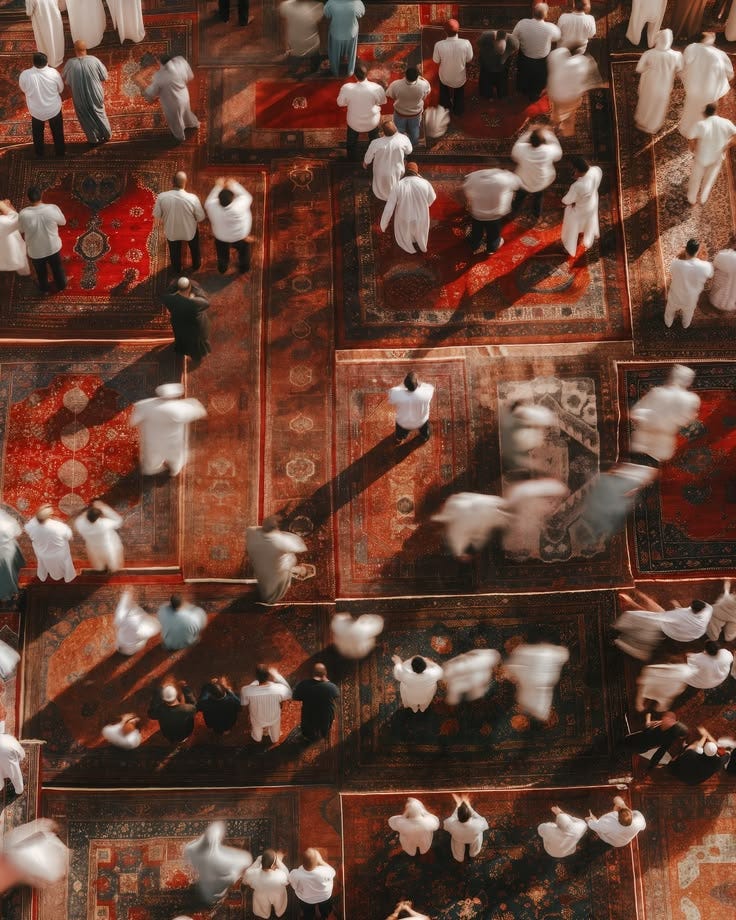
The empty roads echoing distant whispers of a life lived too fast. Flocks of cars parked around the month’s most important locale: the mosque. The mingling of blue and white collars into the closest thing Dubai has to a perfect blue sky. The push toward giving and serving others. The little wholesome rituals - playing cards, sharing a cooked meal, sitting around a table, watching TV - that we take for granted in our express cities. Slow, almost meditative living seeping through every day-to-day activity.
Fundamentally, Ramadan is about two things: the vertical, which is the deliberate, sustained closing of the distance between you and God, and the horizontal, which is the closing of the distance between you and everyone else. The fast is the hinge between them: it strips the body back so the spirit can be heard, and it puts hunger in your body so you can feel it in someone else’s. The Arabic word for it is taqwa, God-consciousness, a state where the awareness of God seeps into every moment and every choice. The practices - sawm (fasting), salah (prayer), zakat (giving), tilawah (Qur’anic recitations) and tawbah (repenting) - are the means. Taqwa is the end.
This year, the means were made more complicated by the geopolitical complications in the Middle East—put simply. The whole month felt like a fever dream. Brains battling between the sound of athan and the sound of fighter jets. A cacophony between taraweeh prayers and shelter alarms; between the opening title sequence of the show you’re watching on Shahid, and a Shahed drone zipping through the sky.
I asked those around me what it was like for them, and their answers oscillated between anger, disappointment and a longer, more intentional reach toward faith. An Egyptian friend living in the UK described experiencing it from a distance. The constant stream of news made it harder to focus on prayer. Instead of calm and connection, there was lingering anxiety and anger sitting at the edges of everything. The spiritual clarity that Ramadan is meant to bring kept slipping out of reach.
In Sharjah, a group of friends made a ritual of visiting different mosques for tahajjud, the late night prayer. The release the prayer brings is the same every Ramadan, she explains, but this year, it was more necessary. Her response was one of leaning into her faith more deliberately.
There was also a collective feeling of disappointment and anger. That woman who made a bulk pre-order of Ramadan home decorations from Temu to ring in the month, expecting to welcome group-after-group of guests nights in a row, hosted almost no one except a newfound understanding of loneliness. Those who wait for Eid, and the long weekend that comes with it, to make their yearly trips, to finally wear that outfit they’ve been planning for the occasion, to spend a sacred day with loved ones, and the rest exhaling on the beach with a mind considerably more at peace. They all had to trade those in for a refund, store credit and the guilt of wanting small things while the world was burning.
Rightfully so. Add to that that this is a group of people already fed up with, and revolted by the empire from the West and its emperor.
To these people, I say this.
I hear you, but I also remind you that your version of Ramadan is the exception, not the rule. For much of the Muslim population in the region, the dissonance exists with and without Ramadan.
For our brothers and sisters in Gaza, there was nothing remotely holy about the last four Ramadans.
In Sudan, where a civil war has pushed roughly half the population into acute food insecurity, involuntary fasting started way before Ramadan, and will continue well after it’s over.
In Lebanon, food prices have risen 65-fold since 2018 and over a million people are currently displaced. Families there come to the iftar table, if they have one, with a calculator.
I also say: the act of observing Ramadan under these conditions is actually the most honest, most faithful expression of the month. To fast when your world is on fire. To pray when your prayers feel unanswered. To give when you have nothing to give. To seek closeness to God when everything around you makes that seeking feel impossible or absurd. That is not something to be disappointed about.
Choosing to still follow the principles of Ramadan - of patience, gratitude, submission and compassion - when everything around you is tempting you in the opposite direction. That choice alone is full of faith.
Saying I will still fast; I will still pray; I will still give; I will still reach is the ultimate spiritual practice. Ramadan was always about that: to close the distance, vertical and horizontal, even when everything is pulling you apart.
This year, for many, it was a big ask but it was still answered. Those who did, whether it’s the one discovering mosques, the one reading Qur’an against the sound of explosions, the one who put together a Plan B for Eid, did more than observe Ramadan; they lived it the way it was always meant to be lived.
Strong piece 👏🏼
I Love it as always, especially the title!