
A (Fashion) Statement Piece
On The Devil Wears Prada 2, In Vogue and the Middle Eastern zeitgeist.

The Devil Wears Prada sequel arrived like a cultural permission slip to obsess, remember and care about fashion again. I personally surrendered completely. My algorithm, ever the enabler, fed me everything: The Office clips quoting the movie, Modern Family snippets of Cam defending Meryl Streep’s honor, behind-the-scenes footage, think pieces. I took it all in with complete delight.
I watched the movie and I definitely have notes, but that’s for a different piece. The subject of this one is a mini series I binged around the same time called In Vogue that traces the rise of fashion in the 90s and its intermingling with celebrity, movies and music. I learned things I had no business not knowing. Did you know Tommy Hilfiger was the first design house to deliberately align itself with hip-hop culture and Black America in the 90s, at a time when the industry wasn’t even glancing in that direction?
Me neither.
The series tells the stories of the world’s major fashion houses in Paris, Milan, England and the United States, from the POV of the quintessential narrator and instigator of the times: Vogue Magazine, its main editorial figures and the legendary Anna Wintour.
For the curious, it’s a very satisfying piece of media. For the curious from the Middle East, you know its (intended) eurocentricity leaves much to be desired.
—
Elie Saab is the first name that comes to mind when thinking of remarkable fashion figures that rose to fame alongside the Galianos, Gianni Versaces and Alexander McQueens of the world, and much in the same manner.
Born in the coastal town of Damour near Beirut, his hands learned to sew before he was ten years old. By eighteen, he had his own label of evening wear in Beirut that very quickly captured the attention of the Lebanese elite. In 1997, Saab became the first non-Italian designer admitted to the exclusive National Chamber of Italian Fashion, Milan Fashion Week’s overseeing body. That same year, his collection walked down the Italian capital’s coveted runway.
If Princess Diana was Galiano’s claim to fame and Nicole Kidman was Gianni Versace’s, Halle Berry was Elie Saab’s. As she got on stage to claim her Oscar for her performance in Monster’s Ball and become the first Black woman to win the Academy Award for best actress, she did it in a beautiful crimson gown with a sheer bodice adorned in green and pink floral embroidery, designed by Elie Saab himself.
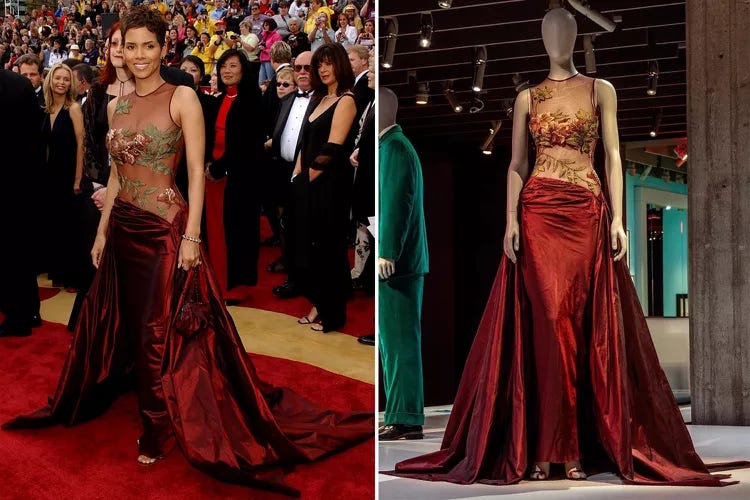
Hale Berry was featured on almost every publication’s best dressed that year. That gown has been immortalized as one of the greatest Oscar dresses ever made. As for Saab, he went down in history, having since dressed everyone who is anyone.
Saab had big shoes to fill. Long before him, Raife Salha, also known as Madame Salha, had already established the region’s first Maison de Haute Couture in Beirut in the 1950s, dressing royals and celebrities with an extravagance that peaked with a record-breaking 22-meter wedding train for Lebanese princess Lamia Solh, and a folkloric gown for Sabah the night she made history as the first Lebanese singer to take the stage at L’Olympia in Paris.
Sabah, who dressed like a woman inventing herself anew with every appearance, had her favorites. Joseph Harouni gave her some of her most iconic movie looks: the bridal gown she wore in a scene with Abd El Halim Hafez in Love Street or the fish-inspired black and white dress she wore singing Ahebak Yani in the 1956 movie, Ezzay Ansak. William Khoury, who designed some 400 of her dresses, built his legacy as the King of Kaftans with his lavish, extravagant creations adorned with gold, diamonds and peacocks, first worn by the legendary Samira Toufic.
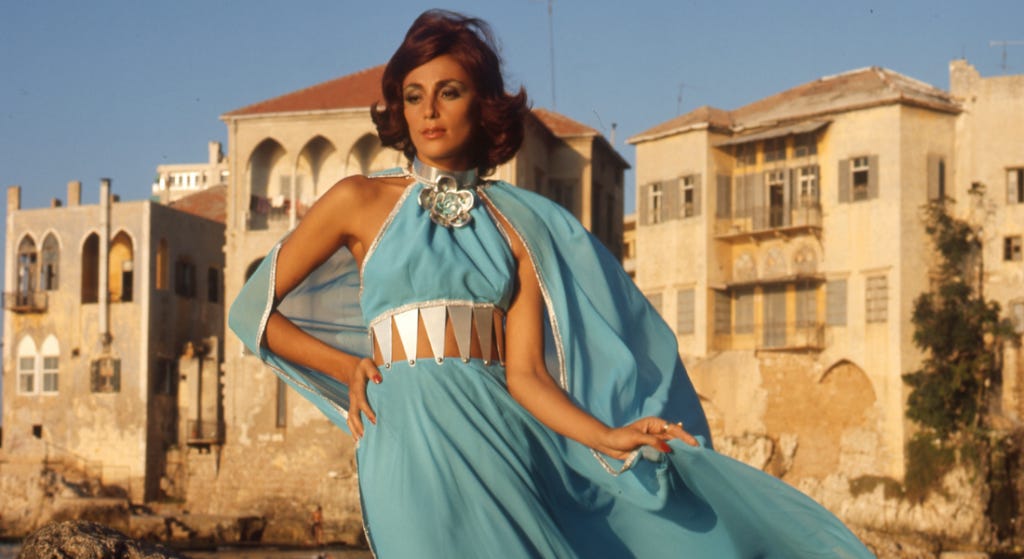
And then there was Jacques Cassia. Avant-garde, futuristic and entirely his own, he worked in metal, chains, paper and plastic, producing designs so flamboyant and ahead of their time that they could have outfitted the entire cast of Star Wars.


Every designer needs a muse. Europe had Kate Moss and Naomi Campbell. We had our own. Andrée Acouri, Felicina Rossi, Mona Ross and Georgina Rizk. These women carried Lebanese fashion on their bodies and took it places. Ross walked for Dior and Balmain in Paris. Georgina Rizk, wearing a daring two-piece gown by Pierre Katra, won Miss Universe in 1971.
I can go on and on about the history of fashion in Lebanon and the wider Middle East, but that could be a book on its own. If you want to know more, visit Lebanese Fashion History on Instagram, where Joe Challita does a fantastic job at archiving Lebanon’s rich and long-lasting love story with fashion.1
What I want to comment on here is why fashion matters.
Fashion is one of those rare spaces where the socio-cultural has a commanding influence. Anna Wintour understood this better than anyone. Her genius, beyond aesthetics, was anthropological: the ability to listen closely and sense the collective mood before it ripened; to move with the times and the spirit of the times. She has an unparalleled evolutionary intelligence, and her sixth sense was the zeitgeist.
Understood as the shared ideas and practices of a generation, the zeitgeist belongs to the people. Alexander McQueen’s breakthrough collection was inspired by a street movement, grunge, that was growing in popularity in the 90s, and stood in direct opposition to everything polished and glamorous that fashion had been up until that point.
Even Anna Wintour, who was totally anti-grunge, ultimately succumbed with a feature called “Grunge & Glory” in Vogue in 1992. Marc Jacobs presented a full grunge collection for Perry Ellis. He was fired for it, but it’s also what fired the rest of his career. The industry always follows, eventually. It has no other choice.
That’s a collective, cultural power rarely found elsewhere.
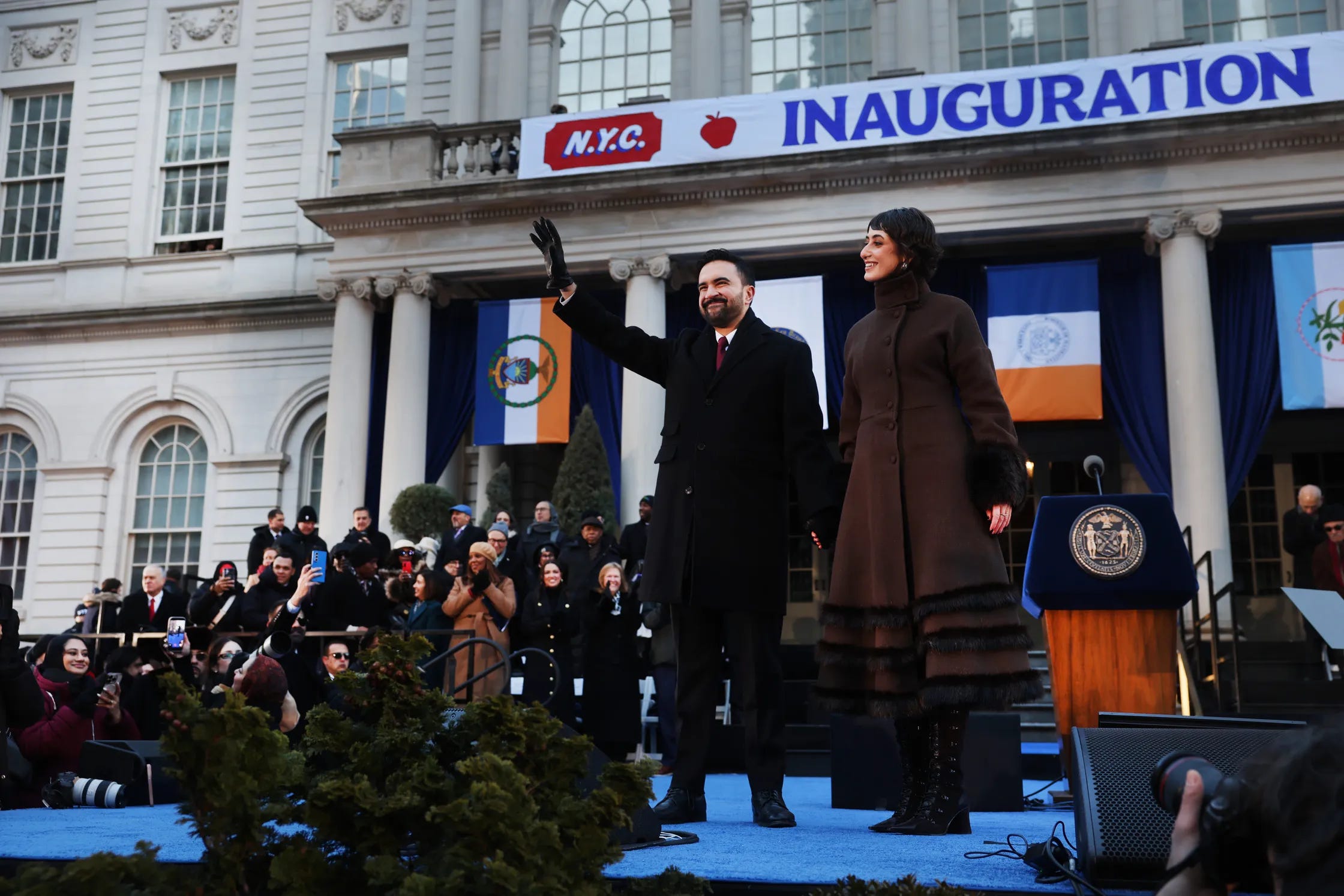
When Rama Duwaji stood beside her husband Zohran Mamdani as he was sworn in as New York City’s first Muslim mayor, the world noticed what she was wearing: a brown funnel-neck coat, chocolate fur lining the cuffs and hem, by Palestinian-Lebanese designer Cynthia Merhej. The reaction was immediate, overwhelming and disproportionate for a piece of clothing. Reading between the lines, it really had little to do with the coat itself and everything to do with what the choice represented: reclamation, a declaration of presence worn on a highly public and political stage. She spoke for an entire generation of powerless, disillusioned citizens who had been watching a genocide unfold before their eyes, and couldn’t do anything about it. The public’s reaction said everything about the spirit of the times.
The true power of fashion is unlocked when culture is its fuel. The zeitgeist of this region right now, postcolonial, anti-establishment, turned inward, hungry, is one of the most creatively charged in the world, and it is already finding its form. New labels are emerging from Cairo, Beirut, Riyadh and Dubai. Fleeting crafts like tatreez, hand embroidery and traditional weaving, are finding new hands and audiences. Designers are reaching into the deep well of this region’s creative inheritance, and pulling something forward.
When a zeitgeist this powerful meets an industry that runs on zeitgeist, the result tends to be extraordinary.
That is perhaps why the Devil Wears Prada sequel also felt like such a collective exhale. What we find at the center of Miranda Priestly is a woman who understood that fashion was never just about clothes. It was about culture and who gets to define the spirit of the times. The runway was a statement, and surrendering it to those who couldn’t feel that, whether the power-hungry capitalists or the self-interested nouveau riche, would be an act of desecration.
The next era of fashion from this part of the world will surely be something to witness. I think both Miranda and Anna would agree.
All references to historic Lebanese fashion designers and models are sourced from Joe Challita’s Instagram account and interviews. Access it here.
Learning new things, piece after piece ❤️